
When art enters a home, it changes forever
Domicilio Particular·GAS® is a very special curatorial proposal that invites art to become part of everyday life. In this way, we transform the private sphere into a stage for contemporary art.
Domicilio Particular·GAS® goes beyond exhibition: it is a reinterpretation of how we see the space we inhabit. Each intervention is a dialogue between the domestic and the artistic, between routine and the extraordinary. It is a way of breaking down barriers, of experiencing art from a place of closeness and pure emotion.

Domicilio Particular·GAS® is an innovative concept conceived by the Ana Serratosa Gallery & Art Spaces and registered in Europe, USA, and Mexico.
It is a spatial intervention in an apartment building carried out by several artists who are assigned a corner of the building to transform the space with their work. This is always accompanied by a curator's narrative, creating a common thread between the two. This intervention seeks to humanize city buildings by giving their inhabitants a sense of belonging, creating a dialogue, and creating a unique experience.
Common and semi-public part of the building
Essential for registration, it encompasses all common areas of the building. These areas include the stairway leading up to the flats from the entrance, the stairwell, and the lift landing.
All of them have been transformed by works created by a selection of artists and curated by a professional who creates a narrative.
Private part of the building
The private part consists of the interior of the building's dwellings. Here, the artists' works also intervene in the living space, but this time in a more intimate way.
Public part of the building
This is the ground floor of the building, also featuring a work by an artist, which becomes a showcase onto the street where it is always on display to passers-by, surprising them as they walk by and making it a unique building.
The public part of Domicilio Particular – GAS50 at Cabillers 5 has been converted into an extension of the Ana Serratosa Gallery, displaying emblematic works by artists exhibited in the gallery or in museum spaces.
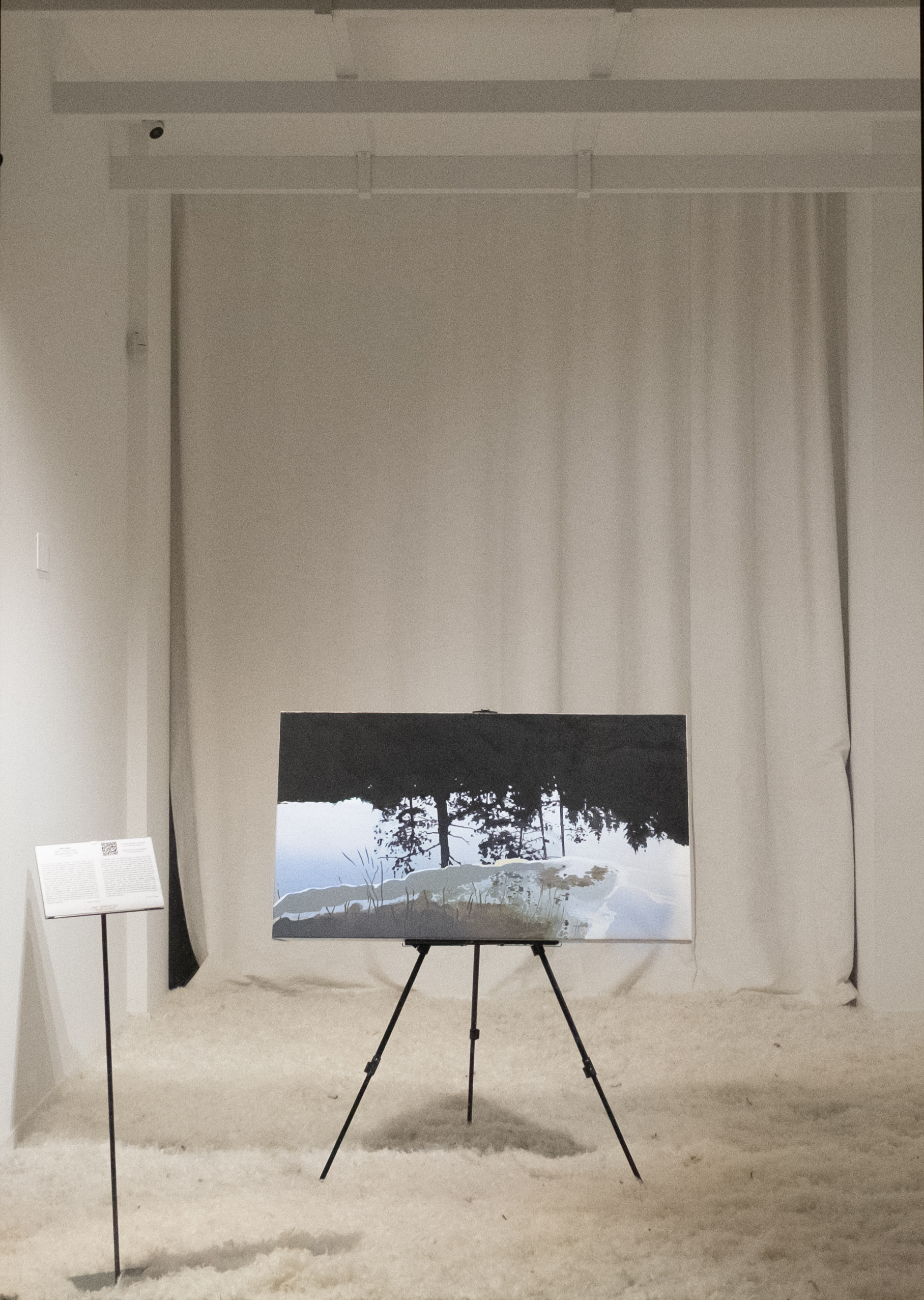
Beatriz Ruibal's work can currently be viewed in the public area of the building.
La piel del olivo (The Skin of the Olive Tree) is part of Botánica frágil (Fragile Botany), an investigation into the plant world, ecology, and forms of disappearance. Within this framework, I work with micrographs of olive leaves to explore both their condition as a living organism and the cultural and symbolic dimensions they have acquired over time.
The olive tree, present throughout the Mediterranean, is bound to life, resilience, peace, and regeneration. It is a tree that rises again after fire, takes root in harsh soils, and persists even in contexts of abandonment or war. Its longevity and capacity to sprout anew make it the custodian of a shared memory that far transcends the strictly human.
In this installation, I displace photographic language toward a spatial dimension. Five suspended panels of fabric enlarge and fragment the leaves' surface, turning it into a second skin—a plant membrane that occupies the space and transforms how we perceive the surrounding architecture. Pierced by light and overlapping before the viewer's gaze, the images acquire an organic presence within the urban landscape.
The piece extends and transforms the spatial language I developed for my intervention at the 32nd Pontevedra Biennial. I am interested in thinking of this membrane as a form of plant hospitality: not viewing ourselves as the sole protectors of Nature but acknowledging that our own lives depend on it and are sustained by it. The installation thus proposes a reversal of the gaze: plant life ceases to appear merely as an object of contemplation and becomes a presence that shelters and holds us.
Beatriz Ruibal
La piel del olivo
2024–2026
Installation on backlit printed fabric
Five panels 350 × 100 cm each
Dimensions variable